

Cybersecurity Threats and Online Safety
The threats of cybersecurity are digital threats which can steal information, destroy systems, halt services or deceive individuals into unprotected behavior. Some of the common threats are phishing, ransomware, malware, identity theft, social engineering, account takeover and data breach.
Online safety refers to the practice of ensuring safety in your habits, privacy and security applications to secure your accounts, devices, money, identity and personal information when you use the internet.
This is a guide to individuals, families, students and seniors, freelancers and remote workers, small business, online stores and larger teams. It discusses the primary risks, as well as the measures which will assist you in remaining safe.
The key to your email account. In case somebody gains access to your email, they can reset numerous other passwords. Therefore, email security is the most appropriate to begin with.
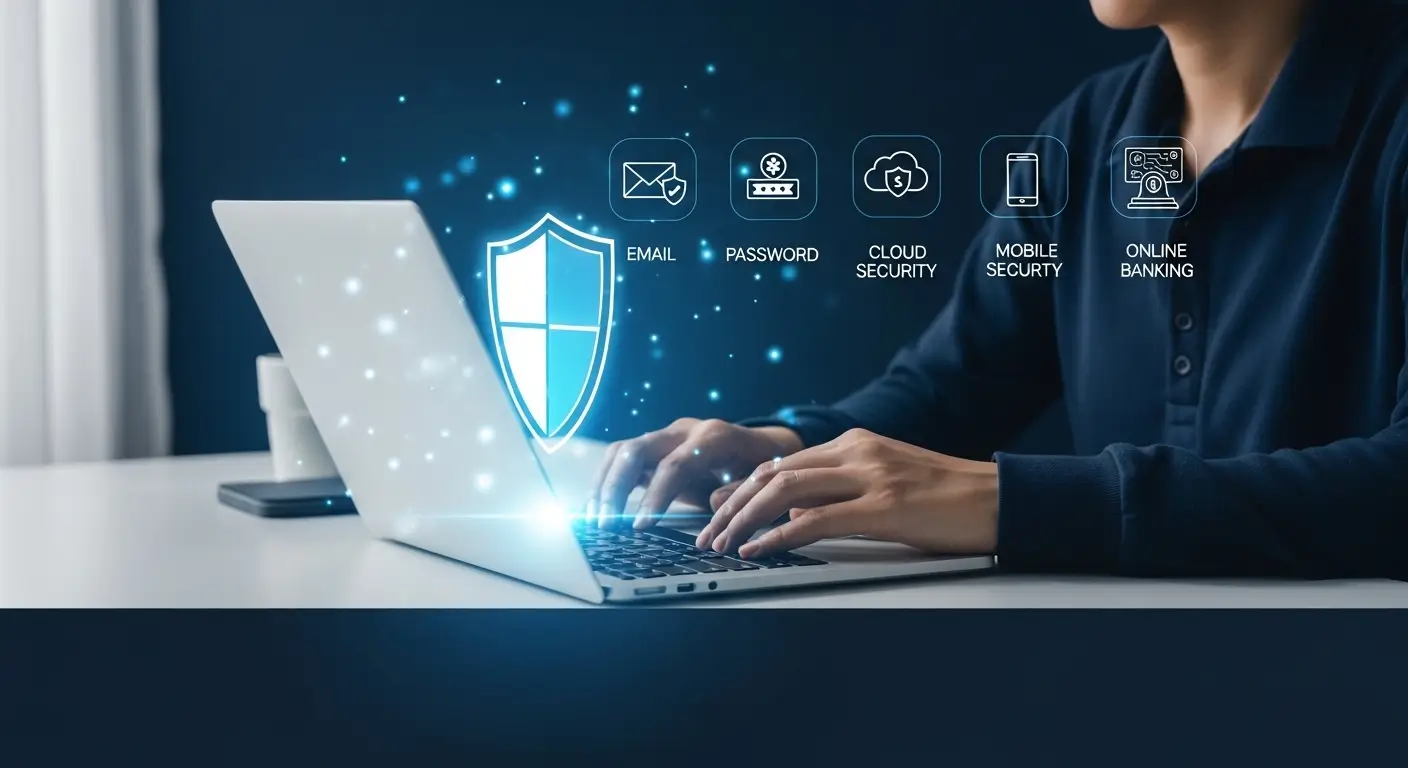
What Are Cybersecurity Threats?
Cybersecurity threats are activities or applications that assault your online existence. They may attack your phone, laptop, email, bank account, site or cloud files, business systems or even your social media profile.
There are those that are done by use of code. There are those who make use of forgery messages. Some use fear. Some use trust.
A threat is so serious when it identifies a weak point. This vulnerability can be a deficient app, a poor password, a reckless click, or a personnel who believes a dodgy invoice.
Why Online Safety Matters
Online security keeps your cash, personal information, family, business and reputation safe. One little slip could result in an account being hacked, bogus payments, stolen files or identity theft.
To a business, it can be more than just that. A cyberattack may halt the operations, reveal sensitive information about customers, and destroy trust, as well as cause legal issues.
The small businesses are not so small to be targeted. Actually, most of the attackers target smaller companies due to their anticipation of weak passwords, ineffective backups and inadequate employee training.
Top Cybersecurity Threats
Phishing
Phishing involves the use of spoofed emails, texts, calls or sites to steal personal information. A phishing email can appear to be sent by your bank, school, courier or boss or payment application.
Common signs include:
- Urgent language
- Strange links
- Requests for passwords
- Fake login pages
- Poor sender address
- Unexpected attachments
- Reports on frozen accounts
You should not believe in a message due to its cleanliness. The numerous counterfeit messages have become authentic.
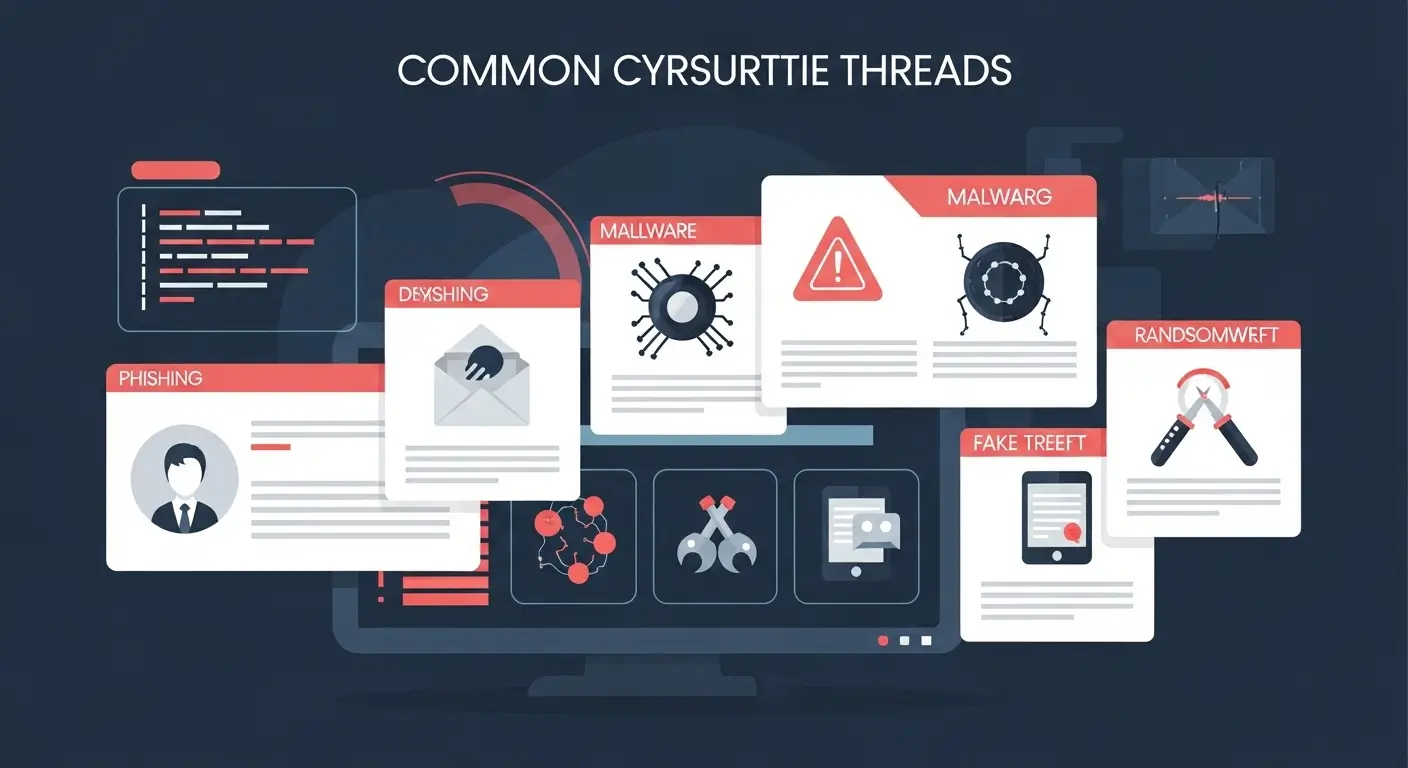
Smishing and Vishing
Scam text messages are referred to as smishing. Vishing refers to phishing on the phone.
A smishing text might indicate that you have a detained parcel, your bank card is frozen or your account requires inspection.
A vishing call can be in the form of your bank, tax department, IT department or delivery department.
Do not share one-time passcodes. Your login code is not necessary to real support teams.
Ransomware
Ransomware will encrypt or steal files and demand money. It has the potential to strike home users, school, clinic, online stores, office, and big companies.
The most important thing is the backups in case of a ransomware attack. With clean backups, then you have a step towards salvation.
Malware
Malware consists of bad software. It has the ability to monitor you, steal passwords, destroy files or provide attackers with access to your computer.
Typical types of malware are:
- Viruses
- Trojans
- Spyware
- Keyloggers
- Infostealers
- Botnets
- Ransomware
Avoid cracked software. One of the least exerted methods of inviting malware is it.
Identity Theft
Identity theft occurs when somebody gets access to your personal information.
Attackers may use:
- Name
- Address
- Phone number
- Bank details
- ID number
- Passport details
- Date of birth
They can open accounts, borrow funds, embezzle funds or cash or write checks on your behalf.
Account Takeover
Account takeover refers to somebody obtaining into your online account. This may impact email, banking, shopping, playing games, social media, and cloud storage or work applications.
Main causes include:
- Reused passwords
- Weak passwords
- Stolen login details
- Fake login pages
- Malware
- No multi-factor authentication
Data Breaches
A data breach is an occurrence where personal information is leaked or stolen. A hack of any of the sites will expose your other accounts in case you have used the same password.
Once you have received a breach notice, change your exposed password. In case you applied it to other places, do it there as well.
AI Scams
Scams are more believable, without necessarily being more technical, with AI.
AIs can be used by attackers to:
- Fake voice calls
- Deepfake video calls
- Fake job interviews
- False customer support online chats
- Fake investment pitches
- Better phishing emails
- Fake profiles
- Synthetic identity fraud
When an urgency, oddness, or too perfection comes across as a message, then slow down.
Common Threats and Risks
| Threat | Main Risk |
|---|---|
| Phishing | Stolen logins |
| Ransomware | Locked files |
| Malware | Device access |
| Identity theft | Fraud |
| Data breach | Exposed data |
| AI scam | Fake trust |
How Cyberattacks Work
A majority of the attacks are straightforward.
The first step is that the attackers select a target. It may be either an individual, family, store, school, clinic or business.
They glean information then. They can utilize social media, hacked passwords, corporate websites, or government documents or past data breaches.
Then they make attempts to gain entry. They can send a phishing email, use a stolen password, or take advantage of a weak application, or deceive a person on the phone.
After getting in they go in search of value. It may be access to the bank, personal information of the customer, personal files, administration accounts, or payment systems.
And finally they gain or do harm. They can rob money, sell information, ransom or even destroy systems.
How to Stay Safe Online
The most effective method to enhance your online safety is to lock up email, apply unusual passwords, multi-factor authentication, software updates, suspicious links, and saving of vital files.
To start with the following steps:
- Use a password manager
- Make different passwords on the accounts
- Enable multi-factor authentication
- Get updates to your phone, laptop, browser and apps
- Make back-ups of valuable files
- Look at links prior to clicking
- Do not use a Wi-Fi in a public place to bank
- Review privacy settings
- Report scams when you see them
How to Secure Your Email Account
A lot of your life on the internet is controlled by your email. Secure it first.
Do this:
- Utilize a powerful distinctive password
- Enable multi-factor authentication
- Delete recovery emails that are not known
- Check account login history
- Check email forwarding options
- Get rid of connected apps
- Use a phone that you are in charge of
In case your email is hacked, immediately take action. Alter password of a secure device. Turn on MFA. Check mail forwarding, filters and sent mail. Next change passwords of important accounts.
Password Security
A good password is lengthy, individual and difficult to figure out.
Some of the bad passwords consist of name, birthday, name of pets, name of school and patterns.
A password manager is able to generate and save a good password. It also assists you to avoid using the same passwords.
There is no better solution than browser saved passwords, however, a good password manager provides more control on devices and users.
| Option | Best For |
|---|---|
| Password manager | The majority of the users |
| Browser passwords | Basic use |
| Security key | High risk |
Multi-Factor Authentication
Multi-factor authentication provides an additional authentication to your password. It is able to use an application code, a passkey, security key, fingerprint or face verification.
MFA prevents much of the account takeover, albeit not all risks.
Stronger options include:
- Authenticator apps
- Passkeys
- The keys used to provide security like YubiKey
- Device-based prompts
SMS codes are superior to no MFA, but are not as strong as app-based or key-based.
Antivirus vs VPN
VPN does not guarantee complete cybersecurity but privacy support. Antivirus and VPNs are solutions to various issues.
| Tool | Main Use |
|---|---|
| Antivirus | Malware blocks |
| VPN | Traffic protection |
| Firewall | Controls access |
| Backup | Restores files |
Do not consider antivirus prevents phishing. It will prevent certain malicious files, however, it will not be able to prevent you from entering your password in a counterfeit page.
Online Safety for Families and Students
Children and pupils are at risk of others. They are: scams in the form of fake giveaways, scams in the form of games, social media scams, fake scholarships, fake job offers, cyberbullying, and unsafe downloads.
Talking about scams should be in simple terms with parents. Block things not only. Learn with children how tricks work.
Some steps to good family steps involve:
- Keep devices updated
- Establish privacy settings in common
- Use strong passwords
- Store cards away (debit and credit) on child accounts
- Teach the children not to share codes
- Review app permissions
- Discuss prior to posting of personal photographs or school information
The students must not use cracked applications, files that are not known, and counterfeit exam links. They need to maintain school accounts on different accounts, as compared to gaming and social accounts.
Online Safety for Seniors
Some of the scams that seniors may encounter include tech support scams, counterfeit bank calls, romance scams, investment scams, and counterfeit family emergency messages.
The most risk-free practice is to get, stop, and check.
Should somebody request money, gift cards, access to the bank or access codes, call a reliable individual initially. Do not use the number highlighted in the message but a known phone number.
Online Banking and Shopping Safety
There is an additional need of online banking.
Use these steps:
- Make use of official banking applications
- Switch on bank notices
- Do not rely on Wi-Fi in the public places
- Check account activity
- Do not share single time codes
- Type the bank website yourself
- Get in touch with your bank in case anything seems amiss
In case of online shopping, verify the web address, terms of payment, policies of returning the goods and contacts. Unbelievable discounts in stores that are not known can be enticements.
Social Media Safety
The social media can assist the attackers to discover about you. They can guess answers using your posts, create a fake account and/or gain trust with your friends.
Protect yourself:
- Keep posts a secret
- Restrict date of birth and address
- Do not put the travel plans on-the-fly
- Review connected apps
- Be aware of the counterfeit support accounts
- Accept not all the friend requests
Cybersecurity for Small Business
A small company requires straightforward, simple protection prior to fancy instruments.
Start with:
- MFA for each staff account
- Team password manager
- Secure email settings
- Regular backups
- Device updates
- Staff scam training
- Admin access limits
- Payment approval checks
- Incident response plan
- Vendor risk review
Business email compromise is a worrisome threat. Do not make any payment on the change of bank details only by email. Phone verification of the change by calling a trusted number.
Cybersecurity for Remote Workers
Workers at the home work with Wi-Fi in their houses, personal devices, cloud applications, and video conferencing. This presents increased attack surface.
Remote workers should:
- Use work-approved devices
- Maintain work and personal accounts separately
- Secure home Wi-Fi
- Lock screens
- Use MFA
- Store data in recommended cloud applications
- Report strange emails
- Do not use any unknown USB drives
Cybersecurity for Ecommerce Stores
Customer information, payments, order information and access to the administration is managed on online stores. That renders them as a target.
The owners of the stores ought to insure:
- Admin accounts
- Payment settings
- Plugins and apps
- Customer data
- Website backups
- Checkout pages
- Staff access
- Fraud filters
WordPress and WooCommerce, Magento and Shopify apps, as well as custom plugins. The presence of one bad plugin can cause a big issue.
How to Spot Phishing Messages
A phishing message can be one that:
- Creates panic
- Asks for a password
- Takes you to a login page
- Uses an unfamiliar address of sender
- Has a reduced connection
- Requests payment
- Refers to a frozen account
- Gives you an impetus to do it
- Gives something excessively good
Beware when unsure, do not run a click. Make a visit to the actual site or application.
What to Do After Clicking a Suspicious Link
There is no need to be panic-stricken in case you have clicked on a suspicious link. Act in order.
- Close the page
- Please not to fill details
- Unplug the device in case of something being downloaded
- Scan the device
- Change password of a secure device
- Turn on MFA
- Check account activity
- Get in touch with your banking institution, in case of money
- Report the message
You entered a password to work with, inform your IT team immediately.
What to Do If Your Account Is Hacked
Use this path:
- Change password using a secure computer
- Turn on MFA
- Sign out of devices
- Eliminate recovery options that are not known
- Check sent messages
- Review linked apps
- Dissuade warnings in case of scams sent
- Check bank and paying activity
- Report the attack
In case one of the business accounts had been hacked, save evidence. Do not remove logs prior to a review.
Global and Local Cybersecurity Help
Others are able to cope with the fundamental safety on their own. Some need help.
Find local assistance when you need:
- Cybersecurity company near me
- Cybersecurity consultant near me
- Data breach response company near me
- Ransomware recovery service near me
- Small business cybersecurity provider near me
- Cybersecurity training near me
Needs all over the globe are different. Cybersecurity services in the U.S. can be based on the requirements of states, cyber insurance and sectors. The UK and European cyber security companies can prioritize on GDPR and NIS2. Local business privacy, payment and industry advice might be required in Singapore, UAE, Canada, Australia, India and Pakistan.
Select a provider having:
- Industry experience
- Clear reporting
- Incident response skills
- Data privacy knowledge
- Backup planning
- Staff training support
- Strong references
- Clear service terms
Cybersecurity Tools and Cost Factors
The free tools can include the fundamental protection. Paid tools can include the following: monitoring, family controls, device protection, business reports, or support.
Costs depend on:
- Number of users
- Number of devices
- Cloud setup
- Compliance needs
- Industry risk
- Monitoring level
- Incident response scope
- Backup needs
- Staff training
Starter updates, MFA, good passwords and backups are the most recommended by most people. Then include paid tools in case of increased risk.
Frameworks and Standards
Cyber risk can be managed by using credible frameworks by businesses.
Common names include:
- NIST Cybersecurity Framework 2.0
- ISO 27001
- CIS Controls
- SOC 2
- PCI DSS
- GDPR
- HIPAA
- NIS2
- OWASP Top 10
- MITRE ATT&CK
You need not be able to master all the frameworks at the first day. Begin with simple controls, and enhance process, access control, reviewing risks, training of employees, and responding to incidents.
Common Mistakes to Avoid
Avoid these mistakes:
- Reusing passwords
- Ignoring updates
- Trusting caller ID
- Sharing one-time codes
- Clicking in a rush
- Using Wi-Fi in the open for banking
- Keeping no backups
- Enabling all staff to have access to the admin
- Downloading cracked software
- Thinking of cybersecurity as a one-time affair
Majority of frauds are based on a sense of urgency, fear, trust or greed. Think before you can touch the screen or type, make a purchase, download, or share.
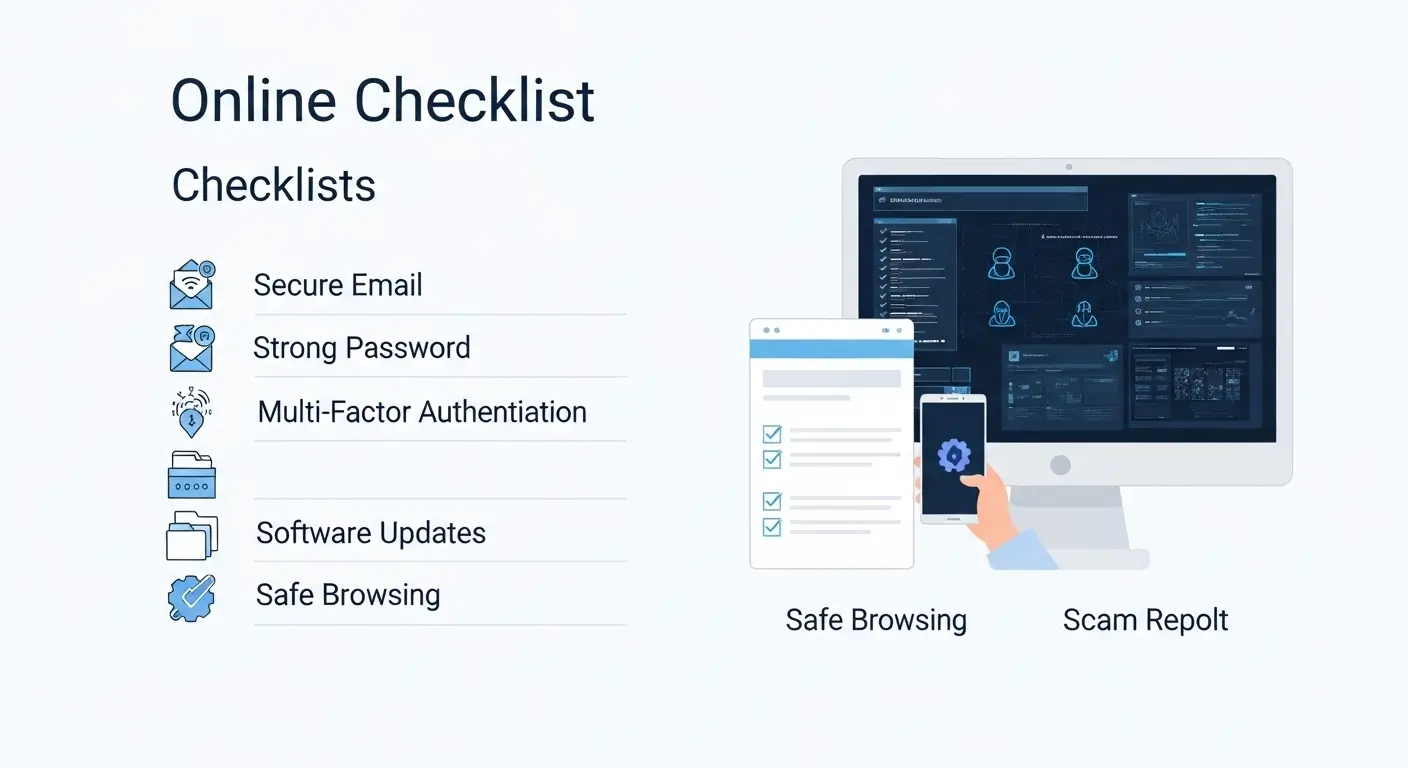
Quick Online Safety Checklist
As a point of departure use this:
- Secure your email
- Use unique passwords
- Turn on MFA
- Update every device
- Back up key files
- Use safe Wi-Fi
- Check privacy settings
- Avoid suspicious links
- Verify payment requests
- Report scams
- Train staff
- Review account access
Entity Glossary
Cybersecurity
Cybersecurity helps to safeguard systems, networks, and devices, as well as accounts and data, against threats in the digital space.
Online Safety
Online safety implies safe practices and applications that safeguard individuals as they utilize the internet.
Phishing
Phishing is a method of stealing data or access with the help of counterfeit messaging.
Ransomware
Ransomware encrypts or takes files and demands a ransom.
Malware
Malware is a bad software which is capable of spying, stealing, damaging or controlling.
Social Engineering
Social engineering employs trust, intimidation or duress to get individuals to engage in unsafe behaviors.
Data Breach
Data breach is the exposure or theft of data which is personal.
Incident Response
The process of responding to an incident in the cyber world to contain, review and recover is known as incident response.
FAQs
Which Are the Predominant Cybersecurity Threats?
Phishing, ransomware, malware, identity theft, account takeover, data breaches, social engineering, business email compromise and AI scams are the primary cybersecurity threats.
What Is the Greatest Problem to Online Safety?
One of the largest threats is phishing as it appeals to the trust of people. An unauthentic email, text or call will steal passwords, money or personal information.
What Should I Do to Be Safe of Cyber Attacks?
Create distinct passwords, enable multi-factor authentication, keep software up-to-date, not to use untrusted links, save files, and review account activity.
Is That All That Is Needed to Be Safe Online; Antivirus?
No. Antivirus assists with malware, but will not prevent all of the scams. You just require MFA, updates, safe browsing, and backups and scam cautioning.
Will a VPN Be Sufficient to Be Safe Online?
No. VPN is not a preventative of phishing, poor passwords, rogue websites, or downloading malware; traffic on unsecured networks can be secured by VPN.
What to Do in the Event That I Have Clicked on a Phishing Link?
Close the page and do not fill in information, scan device, use a different device to change your password, enable MFA, and monitor account activity.
What Can I Do to Be Sure That My Account Is Hacked?
Check suspicious logins, password reset emails, suspicious sent messages, altered recovery information, lost files, new devices or transactions that you did not create.
What Can the Small Businesses Do to Enhance Cybersecurity?
MFA, password managers, backups, training of the staff, access limitations, software upgrades, payment verification, and an incident response plan should be used by small businesses.
What Are Cyber Threats of AI?
Some AI cyber threats are fake voices, deepfake calls, fake job interview, AI-written phishing, fake support chat and synthetic identity fraud.
Should Parents Teach Online Safety to Children?
Yes. Parents will be advised to educate children to not share their codes, click on random links, download unsafe applications, and not leave private information in open spaces.
Conclusion
Cybersecurity and internet safety are concerns of everybody. They impact on students, parents, the elderly, freelancers, remote workers, owners of shops, and big businesses.
To lessen risk you do not have to be a security expert. You should have good fundamentals.
Begin with your email. Use unique passwords. Turn on MFA. Update devices. Back up files. Check links. Keep your bank account secure. Teach your family. Train your staff. Seek assistance when the risk is excessively big.
There is no single tool that is called cybersecurity. It comprises of intelligent habits, protective mechanisms, and composed choices. Prevention is the best cure since it is done before an incident occurs.