

Global Economy Outlook 2026
The world economy forecast of 2026 is towards growth, albeit not smooth sailing. The IMF forecasts that the world economic growth is expected to be 3.1 percent in 2026 and 3.2 percent in 2027 provided that the conflict in the Middle East remains small. It further indicates that the global inflation will just begin to rise in 2026 and then relax in 2027. OECD is a little more reserved, as in the year 2026, global GDP growth is 2.9 per cent and in 2027, it is 3.0 per cent. According to the World Bank, the growth of the world is stabilizing at a low level, which might not be conducive to robust development in the long run.
The big picture is that. The world does not have a general recession situation, but is experiencing a precarious combination of slower growth, elevated prices, energy risk, and policy pressure. The most important question is not to the businesses, investors and policy teams, whether the world will grow. It is Where wilt growth stand and where wilt growth break?
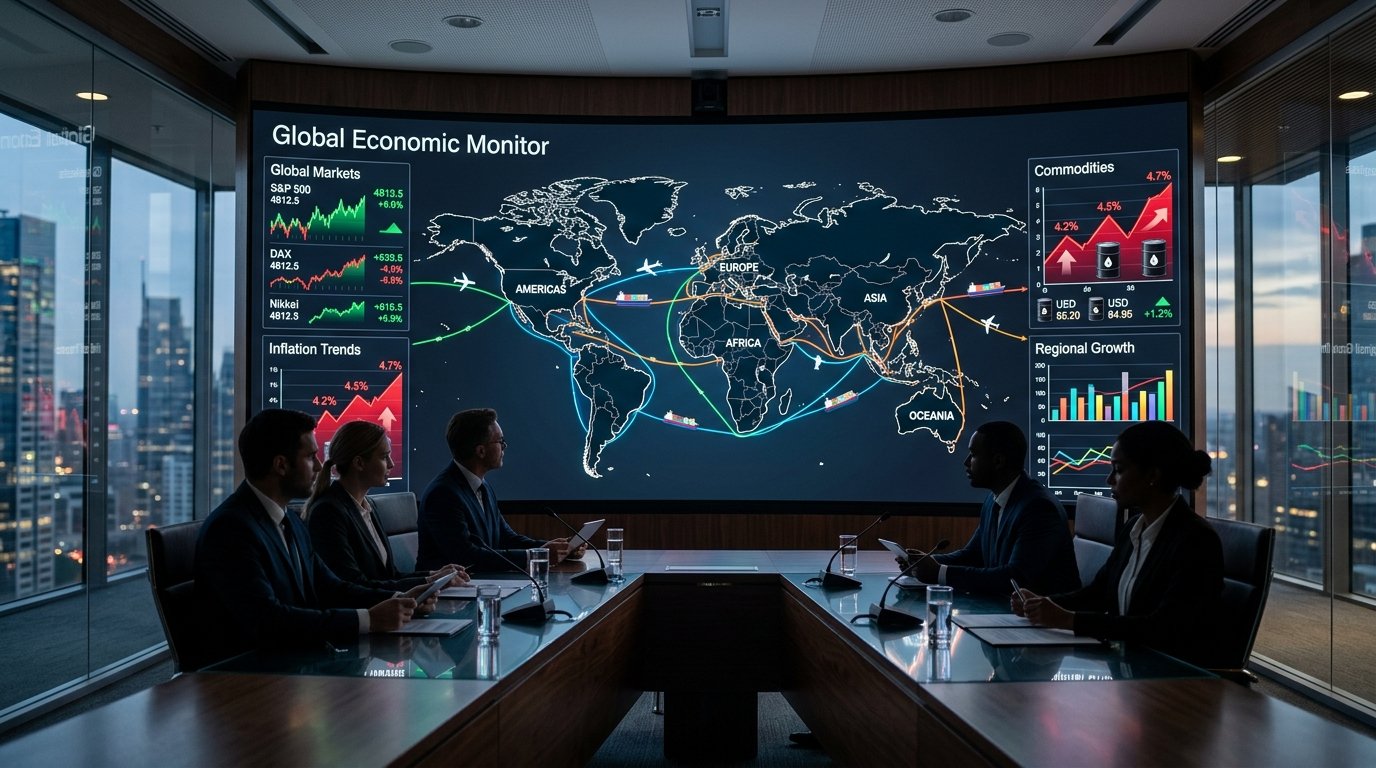
What the 2026 Forecast Means
It is true that 2026 forecast indicates that the world economy continues to have momentum but the momentum is less than that of the past. According to IMF, resilience is being put to test by the increasing commodity prices, an increase in inflation expectations and tighter financial conditions. According to OECD, the increase in energy prices and the conflict in the Middle East increases the costs and reduces demand. Policy uncertainty, trade changes, geopolitical tension, the consistent inflation and climate shocks are all capable of pulling down growth according to the World Bank.
This is simply a year of warning. The growth can be sustained, however, it might not be robust. There are those countries that can be alright. Other people might experience pressure in employment, trade and prices and cost of borrowing.
Why the Global Outlook Matters
This is important since in the global growth, almost all significant business decisions are informed.
It affects:
- sales demand
- hiring plans
- interest rates
- exchange rates
- freight and shipping
- raw material costs
- investment timing
In cases of low growth and the threat of inflation is never dead, businesses will be caught between the crossfire. The turnover may be decreasing and the expenses are on the increase. This is why the 2026 forecast is important to the leaders in any given market, and not economists.
The Three Biggest Forces in 2026
Energy and Conflict
The largest shock risk, which is short term, is energy. OECD indicates that an increase in the energy price trajectory would strike a blow on growth and inflation. According to Reuters, IMF has cautioned that the war may end up in weaker to severe scenarios, depending on the course of the war. In the worst-case scenario, the price of oil might remain close to $110 a barrel in 2026, according to Reuters.
This is important as energy is a source of transport, food, manufacturing and consumer prices. It may also damage trade in case the shipping routes or supply chains experience new strains.
Trade Tension
One of the significant threats is trade. The World Bank cautions the negative change of the trade policy and uncertainty in the policy. The OECD also expresses that the outlook is favorable with a reduction in the effective tariff rates, implying that there is still a real impact of trade policy on growth.
To exporters and importers, this is just but one thing. The tariff risk, customs risk and supplier risk should be included in planning.
Productivity and Technology
Not everything in the news is feeble. According to OECD, investment in technology will help in growth in 2026 and 2027. Reuters also observes that AI and technology have contributed towards the optimism in the market, despite the increase in risk. However, the IMF cautions that the gains in AI productivity might not market across as swiftly as to compensate broader shocks. A big chasm between hope and reality is that.
IMF vs OECD vs World Bank
These institutions concur on the general direction although there may be variation in the figures.
| Source | 2026 View | Main Signal |
|---|---|---|
| IMF | 3.1% | Growth slows, inflation rises first |
| OECD | 2.9% | Energy shock weighs on growth |
| World Bank | Low growth | Risk and uncertainty stay high |
The IMF is the most explicit regarding the conflict shock and also provides a definite figure of growth in the world. OECD is a brief, clean perspective having a high policy base. The most effective warning of poor development in the long-run in case growth remains low is given by the World Bank.
What Changes by Region
The world economy is not a block. The growth of a region can appear quite different as compared to the average in the world.
Europe
Europe and Central Asia are to stabilize at 2.4 percent in 2026, according to World Bank. It states that strong domestic demand will offset a sluggish growth and increase in trade tensions in the euro area.
Asia
According to Reuters, the IMF believes that Asia will be exposed to an energy shock due to a war since most of the Asian economies are fuel importers. It also reports that according to the IMF, the rate of slowdown in Asia is predicted to be 5 percent in 2025 to 4.4 percent in 2026.
Emerging Markets and Developing Economies
According to Reuters, the IMF reduced its forecast of 2026 growth of emerging market and developing economies to 3.9 percent as compared to 4.2 percent in January. That is a clear indication that it is not just a rich-world story of the shock.
Global Development Markets
According to World Bank, global economy is stabilizing at a low growth rate which is inadequate to sustain good development. That is one of the main warnings on the countries which should grow up to alleviate poverty and provide employment.
What This Means for Businesses
The 2026 perspective is a test of planning to businesses.
To answer by guessing a single number is not best. Planning is to plan about a select number of paths.

Base Case
The growth remains, and inflation remains sticky during a period of the year.
Downside Case
Energy prices remain at high and demand is weak.
Better Case
There is decreased inflation, trade, and investment in tech supports output.
This is how to interpret the existing IMF, OECD and World Bank indications. They all refer to uncertainty, rather than certainty.
How to Prepare
1. Watch Costs Closely
Monitor the energy, freight, labor and funding expenses on a monthly basis.
2. Protect Cash
Keep a larger amount of cash when your business is import based, export based or debt based.
3. Diversify Suppliers
Never use a single route, a single country or a single vendor.
4. Test Pricing Power
Test the extent of price increase which your market will support.
5. Build Scenario Plans
Take at least three cases that you may not be broken in your plan by a shock.
What CFOs and Owners Should Watch
| Signal | Why It Matters |
|---|---|
| Oil price | Hits transport and margins |
| Inflation | Changes rates and spending |
| Trade policy | Affects supply and cost |
| FX moves | Changes import and export value |
| Consumer demand | Shapes sales and inventory |
This list is suitable to the manner in which the current 2026 perspective is being packaged by the IMF, OECD, World Bank and Reuters. Uncertainty and cost pressure is the gist of it.
Risks to Keep in View
The most obvious risks are evident.
- longer conflict
- higher energy prices
- wider trade fragmentation
- tighter financial conditions
- debt stress
- less than desired AI profits
IMF predicts that the world will be experiencing a slight increase in inflation in 2026. OECD estimates that another energy outage would lead to even more reduction of growth. The World Bank indicates that there is still uncertainty in policy and negative trade changes that are affecting the prospects.
Why Some Forecasts Still Look Better Than Others
Some of the readers question the reason as to why numbers are not identical.
That is due to the fact that various assumptions are made by each group.
- The IMF presents a global scenario which is conflict-based.
- The OECD believes that the energy disruption at hand is a temporary situation and the prices will come down by mid-2026.
- The World Bank is concerned with an inability to grow over the long term and development risk.
So the contradiction at the gap is not there. It is another pair of spectacles.
Who Should Care Most
This is the attitude that is the most important to:
- business owners
- CFOs
- investors
- exporters
- importers
- policy teams
- supply chain leaders
It is also important to teams in Dubai, Pakistan, Europe, Asia, and other markets that are related to trade since the shock may affect the different regions differently. All the fuel, freight and demand travel by location.
Simple Decision Guide
This guide should be used in case your business is subjected to international expansion.
| Situation | Best Move |
|---|---|
| High debt | Reduce leverage |
| Import costs rising | Reprice faster |
| Weak demand | Protect margin |
| FX risk | Hedge exposure |
| Trade exposure | Diversify routes |
This will be the most feasible manner of utilizing the 2026 outlook. The forecast can only be helpful in case it alters action.
Why the Outlook Still Leaves Room for Upside
The perspective is not just related to risk. Better results are yet to be achieved.
Possible upside drivers:
- faster AI gains
- stronger tech spending
- easier inflation in the future in 2026
- lower tariff pressure
- more reliable source of energy
The OECD explicitly mentions as a supportive factor the investment relating to technology. Reuters also demonstrates that the markets continue to respond negatively to AI optimism even in cases where there is an increase in risk.
Common Mistakes to Avoid
The common errors that most individuals commit are when reading a global forecast.
- They take one report to be a certain fact.
- They do not take into account regional differences.
- They lose energy is quick to switch.
- They have too long to wait in order to stress test cash flow.
- They will be forecasting on the past demand trends.
The more excellent way is easy. Monitor the key risks, revise the plan and maintain options.
FAQs
What Is the Global Economy Outlook for 2026?
It is an outlook that is slow to grow and real. IMF predicts the world growth at 3.1 and OECD predicts at 2.9. Both are alert to inflation and energy stress that is caused by conflict.
Will Inflation Fall in 2026?
Not smoothly. According to IMF, inflation in the world is projected to marginally increase in 2026 but then it will go down in 2027.
Is 2026 a Recession Year?
Not in case of the base. The primary projection is positive, although not as good growth as many would desire.
Which Region Looks Stronger in 2026?
Europe and Central Asia are at 2.4 percent shown by the World Bank. Reuters also adds that Asia has also good growth, albeit with the risk of energy shock.
Why Do IMF and OECD Numbers Differ?
They apply various assumptions on conflict, energy, tariffs and investment in technology. Both continue to indicate reduced growth and an increased risk.
What Is the Biggest Risk in 2026?
The greatest risk is a more protracted energy shock that is associated with conflict and trade stress.
Should Businesses Change Plans Now?
Yes. There should be a number of scenarios that business should plan to. That is the most secure reaction towards the present perspective.
What Data Should Leaders Watch Each Month?
Monitor the oil prices, inflation, trade policy, FX and consumer demand.

Conclusion
The forecast of the 2026 global economy shows an increase, but strained growth. IMF is projected to grow by 3.1 percent, OECD by 2.9 percent and the World Bank cautions the world can enter into the low-growth trajectory that is not robust enough to facilitate widespread growth. The largest forces to consider are the energy shock, trade tension, debt, and policy uncertainty.
The most and the obvious answer is to respond in the best way by the businesses and investors. Anticipate a variety of results. Protect cash. Watch costs. Check regional demand. And have space to manoeuvre in case the picture is reversed by the energy prices or the risk of conflict.